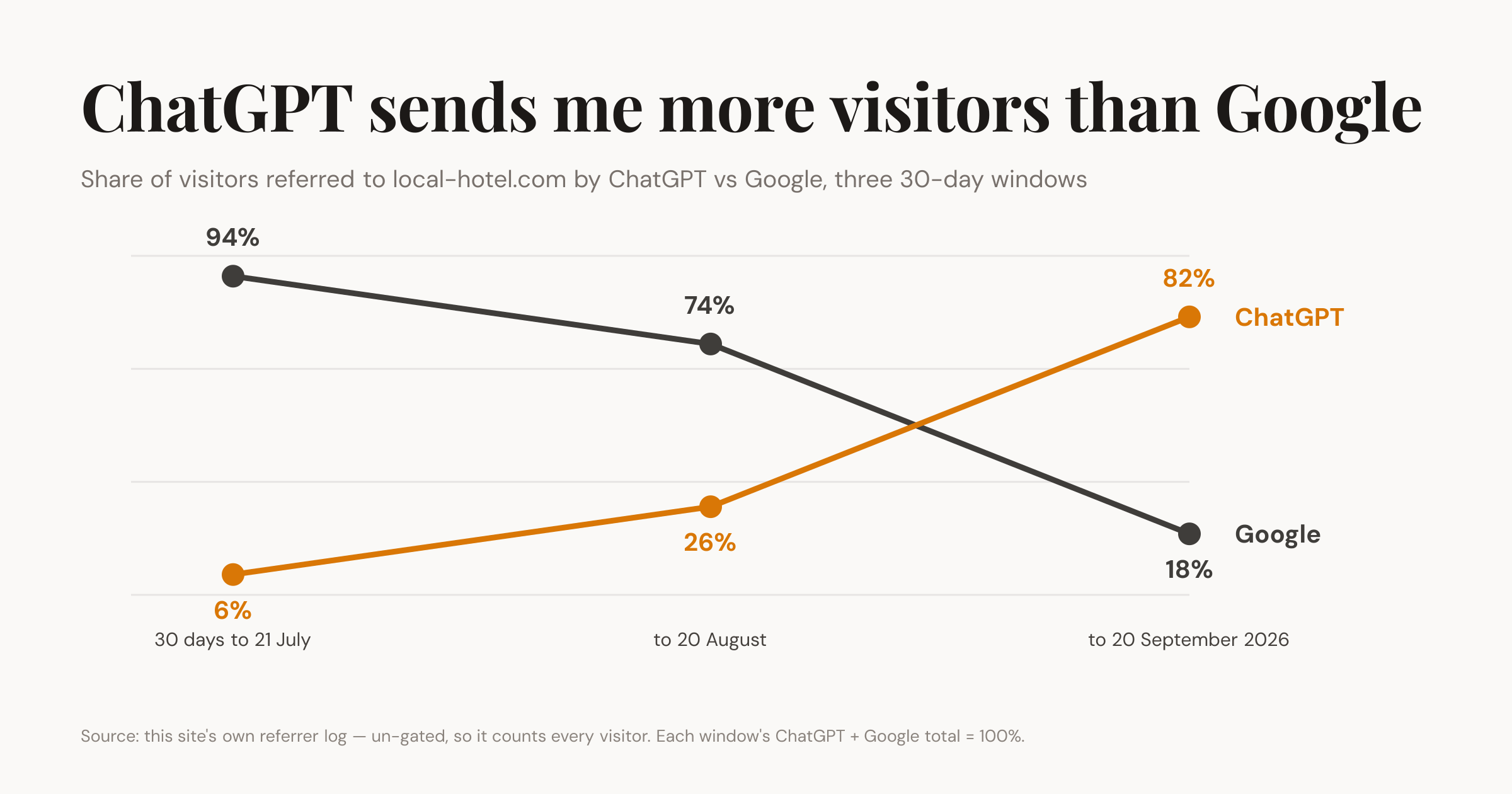
TL;DR — Twice this month I've written about crawlers that read my site and never send anyone back. One of them does send people back, and it has quietly become my largest source of visitors. Three months ago Google sent 94% of the visitors who reached local-hotel.com from either Google or ChatGPT. Over the last thirty days ChatGPT sent 82%. Over the same thirty days Google has 24,867 of my URLs in hand, read the sitemap yesterday, and sent next to nothing. I'm not writing for the walled garden any more. I'm writing for the thing that reads the page, and I'm measuring it — which, it turns out, no search console will do for you.
On the first of the month I wrote about the crawlers that cost me money, and ten days later about the crawlers that replaced them. Both notes ended on the same rule: if a machine never sends a person back, it doesn't get a render.
That rule cuts both ways, and I want to be fair to the machines that pass it. One of them now sends me more people than Google does.
The shift
These come from my own referrer log, not from an analytics product that needs a consent banner. Three consecutive thirty-day windows, whole site, and each source's share of the visitors who arrived from one or the other:
| 30 days ending | From ChatGPT | From Google |
|---|---|---|
| 21 July | 6% | 94% |
| 20 August | 26% | 74% |
| 20 September | 82% | 18% |
Across the quarter, visits from ChatGPT grew roughly twelvefold while visits from Google fell by more than four-fifths.
Two cautions belong next to that table. It is one quarter on one young site, so it shows a direction, not a law. And shares on a site this young can swing quickly, so the trend is the point, not any single month.
What makes the direction worth writing about is that it happened without me doing a single thing to cause it. I did not build links, buy placements, or optimise a title tag for it. I wrote pages that answer specific questions, and an answer engine started quoting them.
One journey from the first week of September shows what that looks like in practice: ChatGPT to my Boston Marathon page, then a search for Back Bay, then an account. It took me five hand-written database queries to reconstruct that path, which is the part of this note that matters most, and I'll come back to it.
The crawl side says the same thing
Every request to my site carries a name, and I sample them into a daily census. Rounded, on a typical day this week:
- OAI-SearchBot — ChatGPT's search crawler: about 1,200 to 1,900 requests a day. The heaviest named crawler on the site.
- bingbot: around 670.
- Applebot: around 310.
- ClaudeBot: 240 on a quiet day, about 1,900 three days ago.
- Googlebot: about 20.
Googlebot reads roughly one page of mine for every sixty to ninety that ChatGPT's crawler reads. That gap is not a conspiracy and it isn't personal — it's a budget decision, and Google has decided my site isn't worth much of one.
Google is not ignoring my content. It never looked at it.
I want to be precise here, because "Google doesn't value good content" is the sort of thing a person says when their site isn't ranking, and it's usually cope.
Here is what I can actually demonstrate. My sitemap offers Google 24,867 pages plus 44,375 images. Google fetched that sitemap yesterday, with zero errors. Over the last thirty days it has barely shown my pages, at an average position of 37.8, and sent next to no clicks; on the three most recent days it didn't show them at all.
Position 37.8 is page four. Nothing on page four is being judged on quality; it never got that far. The pages aren't being weighed and found wanting — they're queued behind every site with more inbound links than mine, which is nearly all of them. Google's index is not a meritocracy of answers, it's a citation graph with a quality filter bolted on top, and a young domain with almost no inbound links sits where it sits regardless of what's on the page.
That's the walled garden, and it isn't malice. It's just a gate that opens for a currency I don't have and can't honestly manufacture.
The contrast is what convinced me. The AI crawlers read the same pages, and the same pages come back out as answers, because an answer engine's job is to find the page that actually addresses the question rather than the page with the strongest backlink profile. My event pages are a good test case: a page about hotels near a specific venue on a specific night is worthless to a link-building strategy and precisely what someone asking a machine wants. Bing's data shows exactly that — my event pages sit at position one for queries like "hotels near a Chicago concert on a given date". Almost nobody asks Bing. Rather a lot of people now ask ChatGPT.
Which is why this isn't a bet against Google
Here's the part I've changed my mind on. Writing for the answer engines isn't abandoning search — it's arriving early at where search is going.
Bing already feeds Copilot. Google already assembles AI Overviews from pages it has crawled. Both of them are, increasingly, machines that read a page and paraphrase the answer rather than handing you ten links. If that becomes the dominant shape of search, then the content that wins is the content the model can lift a clean, correct paragraph out of — which is the same content that wins in ChatGPT today.
So the hedge is free. A page written to be quotable by a model is not a worse page for Google; it's the same page, waiting for Google to catch up. And if it never does, the page is already earning.
The part nobody has instrumented
This is the bit I'd most like someone else to save a week on.
Search Console cannot see any of this. Neither can Bing Webmaster Tools. Both report their own search surface and nothing else. If ChatGPT quotes you and a reader clicks through, Search Console shows you exactly nothing — not a click, not an impression, not a hint. You can have your best traffic week ever and watch a flat line all the way through it.
Consent-gated analytics won't reliably save you either, because a chunk of your visitors decline the banner and vanish from the numbers.
Three instruments actually answer it, and all three are cheap:
- A referrer log that runs without consent. I use GoatCounter, which is open source, sets no cookies, and counts everybody. `chatgpt.com` shows up as an ordinary referrer, which is all the visibility you need. This is the number I trust.
- A crawler census. Sample the user-agent on every server-rendered page into a counter keyed by day. It costs a couple of writes per ten renders, and it answers "is anything reading me" long before "is anything sending me people" has a big enough number to be worth reading.
- Know which surfaces the machines actually hit. I publish an `llms.txt` and a machine-readable endpoint, and I count requests to them separately from ordinary pages. It's a small signal, but it's the difference between guessing and knowing.
None of that is sophisticated. It's just pointed at the right thing. Every dashboard I was handed by default was pointed at the surface that stopped mattering to me first.
What I'm actually doing about it
Nothing dramatic, which is the honest answer. I'm still submitting sitemaps and I'd still take Google's traffic gratefully. But when I decide what to build next, the question I ask has changed. It used to be "will this rank". It's now "if someone asks a machine this question, is my page the best available answer, and can the machine tell?".
Those turn out to be different questions, and only one of them I can influence this year.
Written on 20 September 2026; revised on 30 September 2026 to show referrals as shares of the ChatGPT-plus-Google total rather than raw counts. The figures are my own site's and the proportions are exact.