On Tuesday afternoon, 8 September 2026, NATS, the company that runs the UK's air traffic control, had a failure in its flight-processing system. It did not close the airspace. It throttled departures instead, which was enough to disrupt close to a thousand flights across Heathrow, Gatwick, Stansted, Luton, London City, Manchester, Birmingham and the Scottish airports. NATS reported the fault at about 1:46pm and had a fix in by about 4:40pm. With aircraft and crews out of position, the delays ran into the evening.
I did not need a control tower to watch it. I run a home ADS-B receiver, the kind of hobby box that listens to the position broadcasts aircraft send out, and it logs one number all day: how many aircraft it can see overhead at any one moment. That is not a count of flights. It is a snapshot, taken again and again. This note is about what that snapshot showed, and why a hotel site cares.
What one rooftop saw
I compared each hour of Tuesday with the same hour averaged across the previous seven days. The morning was normal, six per cent under the average, which is inside the usual wobble.
Then the afternoon fell away:
- 1pm: 21 per cent below normal
- 2pm: 43 per cent below
- 3pm: 61 per cent below
- 4pm: 74 per cent below
- 5pm: 88 per cent below, the floor
- 6pm: 81 per cent below
- 7pm: 59 per cent below
- 8pm to 9pm: about 40 per cent below
- 10pm: 58 per cent below
- 11pm: 5 per cent below, which is normal again
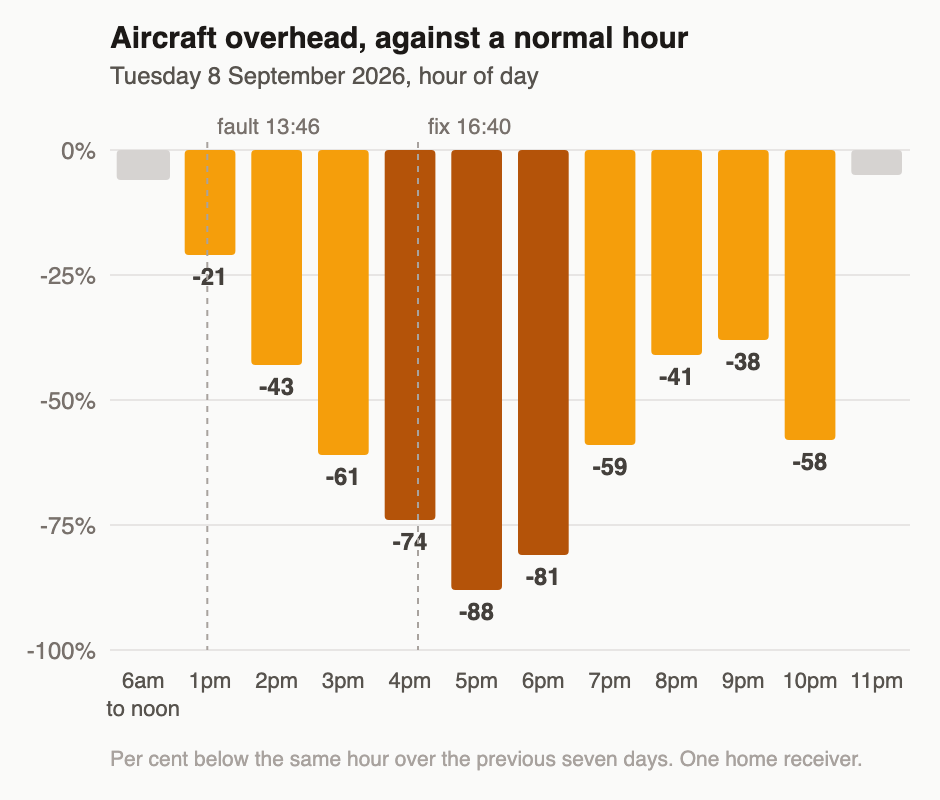
The morning is shown as one block at its average. Grey means within the usual wobble.
The bottom of the curve came at 5pm, after the fix. A flow system coming back does not refill the sky at once. Aircraft that were held on the ground still had to be sequenced out, and the evening's schedule was already out of shape. Every hour from 1pm to 10pm sat below the quietest equivalent hour of the whole previous week, not just below the average. Taken over the day, the sky above that receiver was between 27 and 29 per cent emptier than usual.
I checked that the receiver had not simply dropped out. The morning was normal, the box was offline for about two per cent of the day, and a second count kept independently, the number of position reports it uploaded to Flightradar24, traced the same curve.
One caveat, and I mean it. One receiver sees one patch of sky. This is an anecdote with numbers, not a national measurement. What makes it worth writing down is that the shape matches the official timeline almost to the hour.
Why a hotel site cares about empty sky
On the ground, a disruption like this becomes one very human problem repeated a thousand times: a night away that nobody planned. When flights fall over in the middle of the afternoon, the scramble is not only for a rebooked seat. It is for a bed tonight, near wherever you have been left, at a price you can see before you commit.
That is the case I built this site for. Search a city or an airport, and the prices shown are the prices you pay. If you are reading this from an airport floor, Heathrow, Gatwick and Manchester are the pages to start with.
Sources: AeroTime on the NATS failure and NATS's own statements on the day. The receiver data is my own.