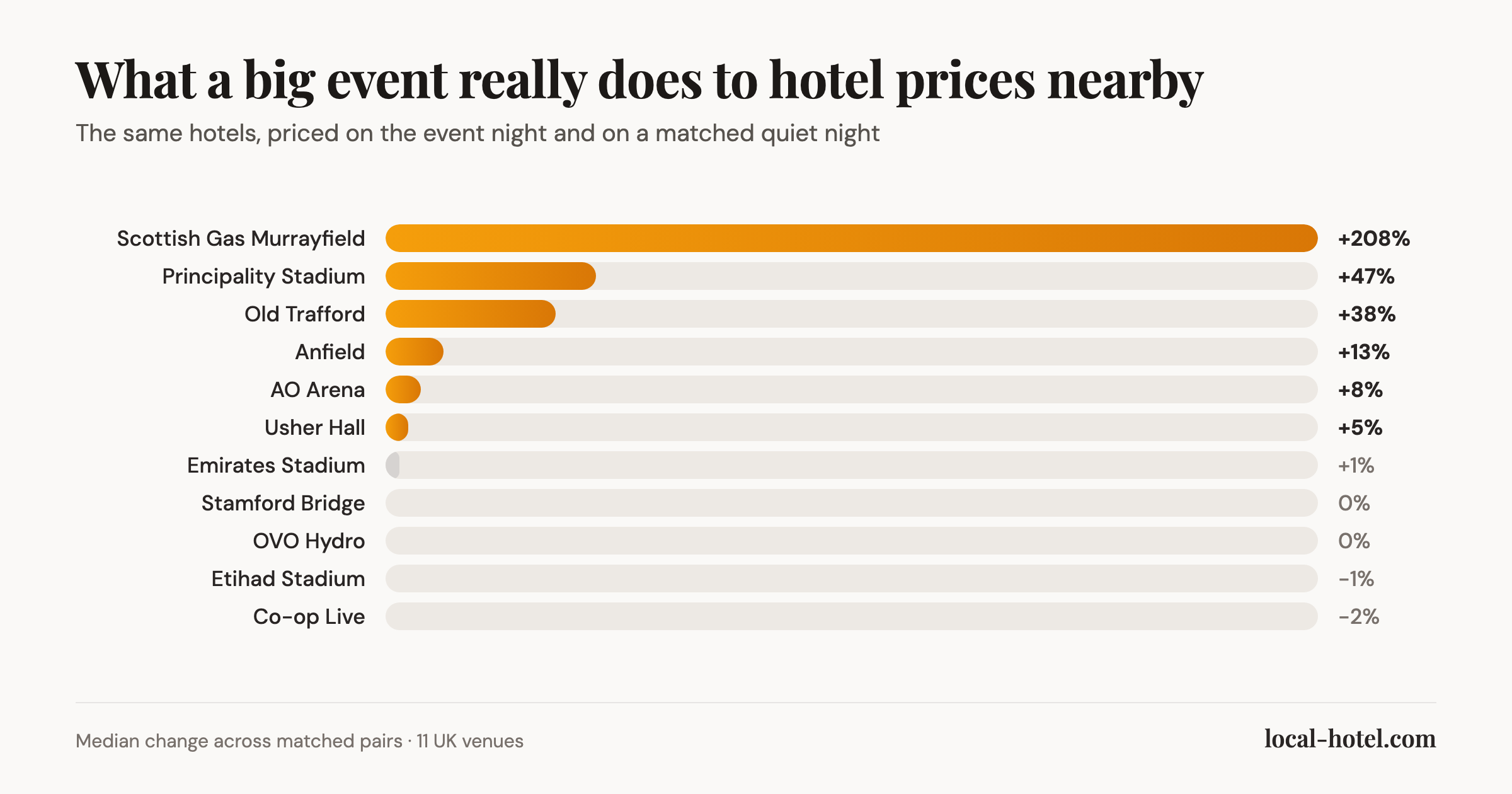
There is a thing everyone knows about hotels: rooms near the ground cost more on matchday. It is repeated often enough that nobody checks it. When I finally measured it properly the headline held up, and the explanation everyone gives for it did not.
How I measured it
A single event-night price proves nothing. If a room near Murrayfield costs £377, that could be the rugby or it could be Edinburgh. The only honest answer comes from comparing the event night against a night that is identical in every respect except the event.
So every figure below comes from a matched pair:
- The same hotel. Not a market average. The same building, priced twice.
- The same weekday. A Saturday compared against a Wednesday measures the weekend, not the fixture. The control night is a whole number of weeks away, so the weekday always matches.
- The same day of observation. Both nights were priced on the same day, so a general market move cannot leak into the result.
- A control night that is genuinely quiet. If the venue has another event on the comparison night, that night is skipped. A club playing at home on consecutive Saturdays is completely ordinary, and it is the most misleading thing that can happen to this measurement: both nights are elevated, the ratio lands near one, and the result reads as "no premium" when really the comparison is broken.
Where no quiet comparison night exists, the event is dropped rather than measured badly.
Each pair yields one number: what that hotel charged on the event night divided by what the same hotel charged on the quiet night. The figure I report per venue is the median of those pair-level changes across every hotel within two kilometres.
The venues
| Venue | Quiet night | Change | Pairs | Hotels | Nights |
|---|---|---|---|---|---|
| Scottish Gas Murrayfield | £120 | +208% | 13 | 13 | 1 |
| Principality Stadium, Cardiff | £156 | +47% | 52 | 32 | 2 |
| Old Trafford | £129 | +38% | 77 | 12 | 8 |
| Anfield | £107 | +13% | 12 | 12 | 1 |
| AO Arena, Manchester | £127 | +8% | 483 | 90 | 7 |
| Usher Hall, Edinburgh | £170 | +5% | 305 | 123 | 6 |
| Emirates Stadium | £147 | +1% | 13 | 9 | 3 |
| Stamford Bridge | £153 | 0% | 139 | 67 | 5 |
| OVO Hydro, Glasgow | £98 | 0% | 125 | 46 | 4 |
| Etihad Stadium | £144 | −1% | 28 | 4 | 7 |
| Co-op Live, Manchester | £116 | −2% | 28 | 3 | 11 |
The quiet night is the median rate those hotels charged on the control nights. The change is the median of the per-hotel changes — not the two price figures divided into each other, which is a different sum that gives a different answer. That distinction is the entire reason for pairing. Pairs, hotels and nights are there so you can weigh each row for yourself.
What it actually says
The premium is real, and it is rarer than the folklore suggests. Of the eleven venues with enough matched pairs to report, four moved by more than ten per cent and five did not move at all. "Hotels near the ground cost more" is true of some grounds and simply false of others.
Three venues in one city, three different answers. Manchester is the cleanest test in the data. Old Trafford adds 38% on an event night. The AO Arena, in the city centre, adds 8%. The Etihad and Co-op Live, side by side in the east of the city, add nothing at all. Same city, same weeks, same method.
The obvious explanation does not survive that test. The intuitive story is scarcity: fewer rooms near the venue, bigger spike. It fits Murrayfield and the Principality, both national stadiums in cities whose hotel stock was never built around them. It fails badly in east Manchester, where the Etihad and Co-op Live have the fewest nearby hotels of any venue here, four and three respectively, and show no premium whatsoever. Whatever is driving Old Trafford, it is not simply the room count within walking distance.
London does not notice. Stamford Bridge sits at zero across 139 pairs, and the Emirates and the Oval are within a point of it. Forty thousand people arriving at a Premier League ground is not an event as far as the London hotel market is concerned. It absorbs that much every ordinary afternoon.
I would rather leave the mechanism open than invent one. What the data supports is a description, not yet a cause: large stadiums outside dense hotel districts can move prices a great deal, city-centre arenas move them slightly, and London moves not at all.
Caveats, because they matter
Murrayfield and Anfield rest on a single event night each. Read them as a signal, not a measurement. The venues carrying hundreds of pairs across several nights, the AO Arena and Usher Hall in particular, are the ones I would stake something on. The pair and night counts sit in the table precisely so you can discount the thin rows yourself.
These are the nightly rates recorded at the moment somebody searched, before what this site adds on top. That does not touch any percentage here, because the same fee sits on both sides of a ratio, but it does mean the pound figures are not quotes.
The record begins on 26 July 2026, so every night measured here is recent, and there is far more data close to a stay than far from it.
One bias runs in a known direction. A hotel that has sold out has no rate to record, so it drops out of the data entirely, and the busiest rooms on the busiest nights are exactly the ones most likely to be missing. If anything, the premiums here are understated.
What I would do with this
If the venue is a national stadium, or a ground sitting apart from a city's hotel district, treat the room as scarcer than the ticket. Book it the day the date is announced, take free cancellation, and stop thinking about it.
If the venue is an arena inside a big city, or anywhere in London, relax. The evidence says the event will barely move your price. What will move it is the ordinary rhythm of business travel, which has nothing to do with the gig.
Either way, compare the total for the whole stay rather than the headline rate, and price a stop or two further out. On the nights when the premium is real, it falls away quickly with distance.
I will keep this current as the record deepens and as more venues collect enough pairs to be worth reporting.